
Fillmore County Unclaimed Money
Fillmore County residents searching for unclaimed money should use the Minnesota Department of Commerce state portal, which holds unclaimed funds from across all 87 Minnesota counties. Dormant bank accounts, forgotten insurance proceeds, uncashed checks, and other financial assets tied to Fillmore County names and addresses are stored in the state's database. There is no county-level system for unclaimed property in Minnesota. The search is free, the claim process is free, and the state holds property with no expiration date.
Fillmore County Overview
Where Fillmore County Unclaimed Money Is Held
All unclaimed property in Minnesota flows to the state's Department of Commerce. Fillmore County has no separate unclaimed money office or local database. When a company that operates in Fillmore County loses contact with a customer or account holder, those dormant funds go to the state after the dormancy period ends. The state keeps a permanent record linked to the owner's name.
The Fillmore County official website handles local government services including the Fillmore County Auditor-Treasurer, which manages local taxes and financial records. Neither the county website nor the Auditor-Treasurer's office tracks unclaimed property from private businesses or financial institutions. That is the state's job.
The state search portal at minnesota.findyourunclaimedproperty.com is the one official tool for finding and claiming unclaimed money in Fillmore County. The screenshot below shows the Minnesota state portal, which covers every Minnesota county including Fillmore.
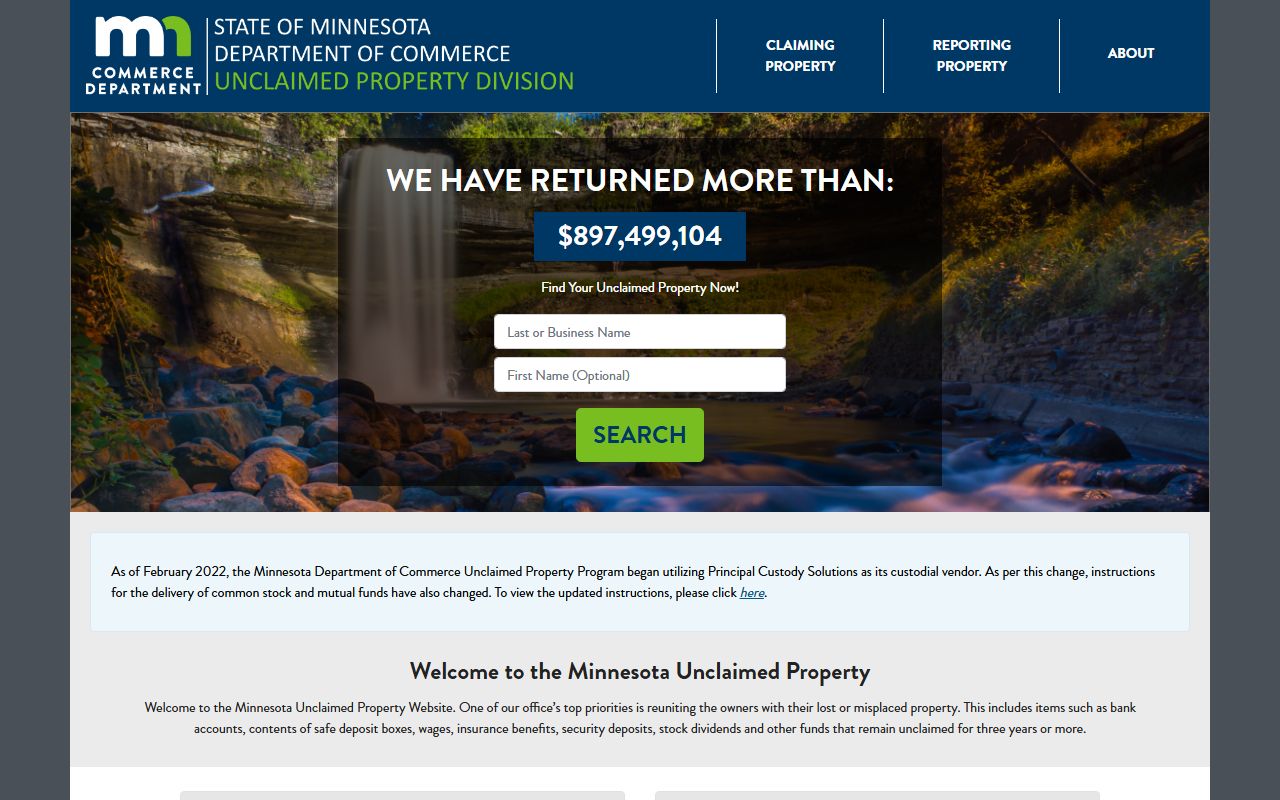
Start your Fillmore County search here. The portal is open at all hours and does not require account setup or login.
How to Search Fillmore County Unclaimed Property
Type your last name into the state portal's search bar. The system searches the full database and returns all matching results. You can also search by first name or partial name if your last name is very common. No account or login is required.
Try different name versions. A maiden name, a name from a previous marriage, or a commonly misspelled variant can all pull up different results. People miss unclaimed money by only searching under one version of their name. This is especially true for women who have changed their name multiple times or for people whose names have unusual spellings that get recorded differently by different institutions.
Business names are worth checking too. If you've run a farm operation, a shop, or any type of registered business in Fillmore County, search those names separately. Old sole proprietorships, dissolved LLCs, and closed businesses can all have unclaimed property on file with the state.
The multi-state database at MissingMoney.com is a helpful add-on search. It searches Minnesota plus many other states at once. If you moved to Fillmore County from another state, you might have unclaimed property there as well. The tool is free, endorsed by NAUPA, and requires no registration. Don't pay a private finder's service. The same data is available to you at no cost.
Types of Unclaimed Property Held for Fillmore County
Bank accounts are the most frequent source. Checking accounts, savings accounts, and CDs go dormant after three years of no owner contact. When the bank can't reach the account holder after following its outreach procedures, the balance transfers to the state. The account is closed, but the funds stay in the state's database indefinitely under the owner's name.
Uncashed checks from many sources end up in the fund. Utility companies issue refund checks that never get deposited. Retailers send rebate checks to old addresses. Insurance companies mail premium return checks that go missing. Former employers issue final checks that get lost in transit. All of these become unclaimed property when they go uncashed long enough for the issuer to hand them over.
Life insurance benefits are a significant category on their own. When a policyholder dies and the insurer can't locate the named beneficiary, the death benefit sits with the insurer until the dormancy period ends and then transfers to the state. A beneficiary who didn't know a policy existed won't know to file a claim. That money sits in the database waiting. Annuities and health insurance overpayments follow the same pattern.
Securities and brokerage accounts, mutual fund balances, and stock dividends also wind up unclaimed when brokerages lose contact with account holders. Safe deposit box contents are held for five years before transfer. Everything else typically follows a three-year dormancy. Minnesota Statutes Chapter 345 covers all of this and includes a 2019 amendment requiring interest to be paid on interest-bearing property.
Claiming Fillmore County Unclaimed Money
Find property in your name through the state portal. Click to begin a claim. The portal will walk you through the steps and explain exactly what documents to submit. For most personal claims, a government-issued photo ID is the main requirement. Driver's licenses and passports both work.
Heir claims require more documentation. If you're claiming property on behalf of someone who has died, you'll need a death certificate and evidence of your legal standing, such as letters testamentary from probate court, a court order naming you as administrator, or a notarized affidavit of heirship if the estate didn't go through formal probate. The state reviews each claim individually and may ask follow-up questions.
Submit documents through the portal or by mail. You'll receive a Claim ID after submitting. Use it to track progress. Allow 90 days from submission before following up. After that window, call 651-539-1545 or toll-free 1-800-925-5668. You can also email unclaimed.property@state.mn.us or write to Minnesota Commerce Department, 85 7th Place East, Suite 280, St. Paul, MN 55101. Claim requirements are described in Minnesota Statutes §345.41.
Minnesota Unclaimed Property Law
Minnesota Statutes Chapter 345 is the governing law for unclaimed property in Minnesota, including Fillmore County. The law requires banks, insurance companies, utilities, brokerages, and other businesses to report dormant property to the state after the relevant dormancy period ends. Most financial assets reach the three-year mark. Safe deposit boxes are given five years.
Before reporting to the state, a holder must try to contact the owner. For property worth $100 or more, this means sending written notice to the owner's last known address at least 120 days before the annual report deadline. This due diligence requirement is built into the law to protect owners. Holders that skip this step are noncompliant. Annual reports are due by November 1. Life insurance companies must file by October 1.
Noncomplying holders face penalties under Minnesota Statutes §345.55. Willful failure to report can become a gross misdemeanor. The state may charge 12% interest on wrongly withheld amounts. These enforcement rules are aimed at companies and institutions, not at people filing legitimate claims for their own funds.
Additional Search Resources
The NAUPA Minnesota profile offers a clear overview of Minnesota's unclaimed property program. MissingMoney.com searches Minnesota and other states in one step. The NAUPA national site links to every state's program if you need to check elsewhere. All of these are free.
The Minnesota State Auditor's unclaimed property page is informative for understanding how public entities handle these funds. If you have a connection to a federal bankruptcy case in Minnesota, check the U.S. Bankruptcy Court for Minnesota's unclaimed funds list. Federal bankruptcy funds are separate from the state database and require their own search.
Why Fillmore County Residents Miss Unclaimed Money
Most people don't know their money has been transferred to the state until they search the portal. A check issued to an old address and never forwarded. A bank account that got lost in a move. An insurance policy from a deceased parent that the family never knew about. These situations are common. They don't require any wrongdoing to happen. People just lose track of financial accounts over years and decades.
Searching takes only a few minutes. Even if you don't expect to find anything, it costs nothing to look. Many Fillmore County households are surprised to discover multiple entries in the database across different family members' names. The state has no incentive to keep the money. The whole point of the database is to return it.
Nationally, about one in seven people has some form of unclaimed property. The average value of a claim runs around $2,080, though the range is broad. Checking once and then rechecking every couple of years is a reasonable habit. New property gets reported to the state on a rolling basis, so a name that comes up empty today might have a new match in a year or two.
Nearby Counties
Residents near Fillmore County borders may also want to search records in adjacent counties.