
Lincoln County Unclaimed Money
Lincoln County residents may have unclaimed money on file with the Minnesota Department of Commerce. The state holds dormant bank accounts, uncashed checks, forgotten insurance benefits, utility deposits, stock dividends, and other financial property that businesses reported after losing contact with their owners. Anyone in Ivanhoe or across Lincoln County can search the statewide database at no cost and file a claim without paying a fee. Property is held indefinitely, so there is never a deadline to look.
Lincoln County Overview
Where Lincoln County Unclaimed Money Is Held
Minnesota's unclaimed property program runs at the state level through the Department of Commerce. Lincoln County has no local unclaimed property database or county office handling these funds. When a bank, insurance company, utility, or other business loses contact with a Lincoln County customer after the dormancy period ends, state law requires the property to transfer to the state. The state holds it until the rightful owner or heir files a claim.
The Lincoln County official website serves county residents with local government services, but unclaimed property is not within its scope. For unclaimed money, the state portal is the only tool you need.
The screenshot below shows the Minnesota state unclaimed property search portal, the official tool for finding and claiming funds held by the Department of Commerce.
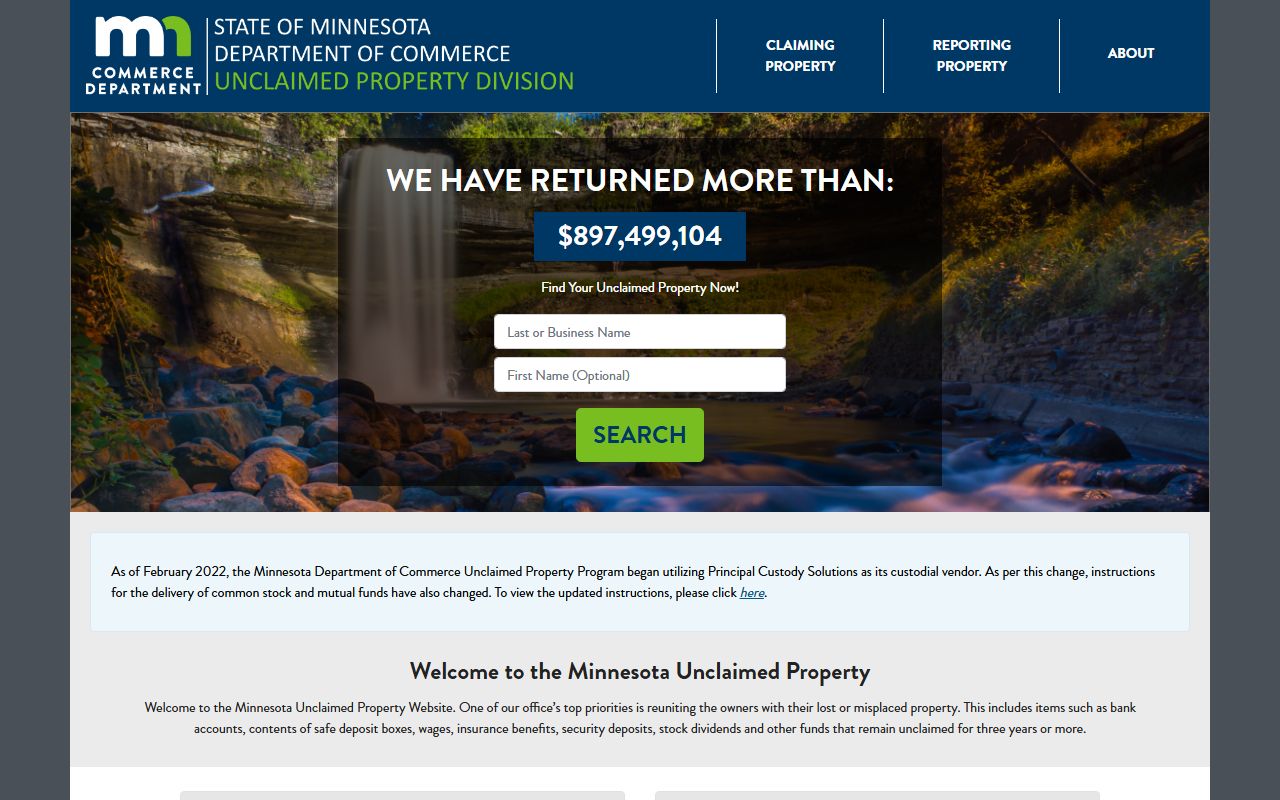
The portal at minnesota.findyourunclaimedproperty.com searches the full statewide database, including all Lincoln County records. It is available to anyone and requires no login or account to use.
How Lincoln County Residents Search the Database
The search is fast and straightforward. Go to minnesota.findyourunclaimedproperty.com and enter your last name. Look through all the results. Then try again with alternate versions of your name. A maiden name, a former married name, and any nicknames used on old bank or insurance accounts can each pull up different records. Don't stop after one search. Running a few variations takes only a few extra minutes and can make the difference between finding property and missing it.
Searching for deceased relatives is also worth doing. If a parent, grandparent, or spouse had property linked to a Lincoln County address that was never claimed, you may be entitled to it as an heir. Enter their name in the search box. The state holds property for heirs without an expiration. If you find something tied to a deceased person, documentation of your relationship will be needed to complete a claim.
For searches covering other states, MissingMoney.com is a free option backed by the National Association of Unclaimed Property Administrators. It searches multiple states at once and is especially useful if you've lived in South Dakota, Iowa, or other states at any point. There is no reason to pay a finder service. Both the state portal and MissingMoney.com are free.
Types of Property Reported in Lincoln County
Dormant bank accounts are the most frequently reported category. A checking or savings account that sits inactive for three years with no response from the account holder gets transferred to the state. This covers accounts at any bank or credit union that served Lincoln County customers. Certificates of deposit and money market accounts follow the same three-year rule. Many of these accounts belong to people who moved away from Ivanhoe or surrounding towns and forgot about old accounts they left open.
Uncashed checks come from many sources. A final paycheck from a Lincoln County employer, a class action settlement payment, a utility credit at account closure, a merchant refund, or a government payment can all end up as unclaimed property. Dollar amounts range from small to substantial. The state holds all of them without a minimum threshold.
Life insurance benefits are a major source that often goes overlooked. Many Lincoln County families don't know about policies that relatives held years or decades ago. When an insurer can't locate beneficiaries after a policyholder dies, the benefit transfers to the state. Annuities, premium refunds, and health insurance reimbursements also show up in the fund. Securities including stock dividends, old brokerage account balances, and inherited mutual fund shares are reported by financial institutions each year. Safe deposit box contents are turned over after five years of no activity, while most other property enters the state fund after three years, per Minnesota Statutes Chapter 345. About 1 in 7 people nationally have some form of unclaimed property. Average claims run around $2,080.
How to File a Claim for Lincoln County Property
After finding property in your name through the state portal, the claim process runs through four stages: search, submit a claim online, complete verification with documents, and track the outcome using the Claim ID you receive after filing.
For most individual claims, a government-issued photo ID is all that is required. A driver's license or passport works. The state confirms your identity before releasing property. For estate claims filed on behalf of someone who has died, additional documents are needed. A death certificate is standard. Depending on the property type and value, you may also need a will, letters testamentary, or a court order showing your legal authority to receive the funds. Preparing documents before starting your claim saves time, since you can upload everything at once.
Claims are processed in up to 90 days. After filing, keep your Claim ID. If the claim hasn't resolved after 90 days, contact the Department of Commerce at 651-539-1545 or 1-800-925-5668 toll-free. Email is unclaimed.property@state.mn.us. Mail goes to Minnesota Commerce Department, 85 7th Place East, Suite 280, St. Paul, MN 55101. Filing requirements are in Minnesota Statutes §345.41. No fees apply. No expiration date applies to unclaimed property.
Minnesota Unclaimed Property Law
Minnesota Statutes Chapter 345 is the main law governing unclaimed property in the state. It applies to Lincoln County the same as every other county. The law defines dormancy periods, sets annual reporting deadlines, and requires holders to make reasonable efforts to reach owners before transferring property to the state. Most financial assets become reportable after three years. Safe deposit box contents require five years of inactivity.
The notice requirement is significant. Before reporting property worth $100 or more, a holder must send written notice to the owner's last known address at least 120 days before the November 1 reporting deadline. Life insurance companies file by October 1. In smaller, rural counties like Lincoln, people move frequently enough that these notices often go to outdated addresses. Many never see them, which is one reason unclaimed property continues to accumulate in the state fund.
Businesses that fail to report, report late, or intentionally withhold property face penalties under Section 345.55. Willful non-compliance can rise to a gross misdemeanor. The state charges 12% interest on withheld amounts. A 2019 update added an interest obligation on interest-bearing property held by the state in the unclaimed fund. This means older claims involving interest-bearing accounts may now be worth more than the original reported balance.
Additional Resources for Lincoln County Residents
The NAUPA Minnesota profile provides an overview of the state program and links to the official search portal. The NAUPA national site lists programs in all 50 states, which is useful for people who have lived in multiple states. Both are maintained by the National Association of Unclaimed Property Administrators and are free to use.
The Minnesota State Auditor's guidance on unclaimed property explains how the program works for local governments and public entities. For federal bankruptcy-related unclaimed funds, the U.S. Bankruptcy Court for Minnesota maintains a separate list. These funds are not included in the state Commerce database. If you were a party or creditor in a federal bankruptcy case, checking the court's list separately is worthwhile.
Lincoln County Unclaimed Property by Source
Bank accounts make up the largest share of reported property statewide. Lincoln County residents who moved away from Ivanhoe and surrounding communities may have balances sitting in the state fund from accounts they forgot to close. Even very small balances are reported. The state holds everything with no minimum threshold.
Uncashed checks flow into the fund from many directions. Paychecks mailed to former addresses, government benefit checks, court-ordered refunds, and merchant credits all end up here if no one deposits them within the dormancy window. These checks can sit in the system for years before an owner finds them.
Life insurance is worth a careful look, especially for people whose older relatives held policies they never talked about. When beneficiaries can't be found after a policyholder dies, the benefit transfers to the state. Annuities and health refunds follow the same path. Old brokerage accounts, employer stock programs, and inherited shares are reported by financial institutions each year. Safe deposit box contents, including coins, jewelry, documents, and other items stored at bank branches that changed hands or closed, enter the state's possession after five years of no activity. Nationwide, about 1 in 7 people have some form of unclaimed property. The average value of a claim runs around $2,080.
Nearby Counties
These counties border Lincoln County. All use the same Minnesota state unclaimed property system.