
Cook County Unclaimed Property Search
Cook County unclaimed money is held by the Minnesota Department of Commerce on behalf of all current and former residents of the county. Cook County government does not maintain a separate unclaimed property database. If you have had bank accounts, insurance policies, or other financial accounts in Grand Marais or anywhere in Cook County, the state portal may have unclaimed funds in your name. You can search for free at any time and there is no expiration date on claims.
Cook County Overview
Finding Cook County Unclaimed Money
Cook County sits at the far northeastern tip of Minnesota along Lake Superior and the Canadian border. Grand Marais is the county seat. The county is known for the Boundary Waters Canoe Area Wilderness and draws a significant number of seasonal visitors and seasonal property owners in addition to its permanent residents. All of these people, whether full-time locals or part-time cabin owners, may have unclaimed property in the state database.
Banks, credit unions, insurance companies, and other businesses operating in Cook County report dormant funds to the Minnesota Department of Commerce. The county has no role in that process. Search the state database at minnesota.findyourunclaimedproperty.com. Enter your name and look through the results. The listing shows property type, approximate value, and the name of the business that held it before reporting it to the state.
The Cook County official website covers county government services. The county site does not have an unclaimed property database. All searches and claims go through the Minnesota state portal.
The Minnesota state search portal is shown below. It is the starting point for any Cook County resident looking for unclaimed property.
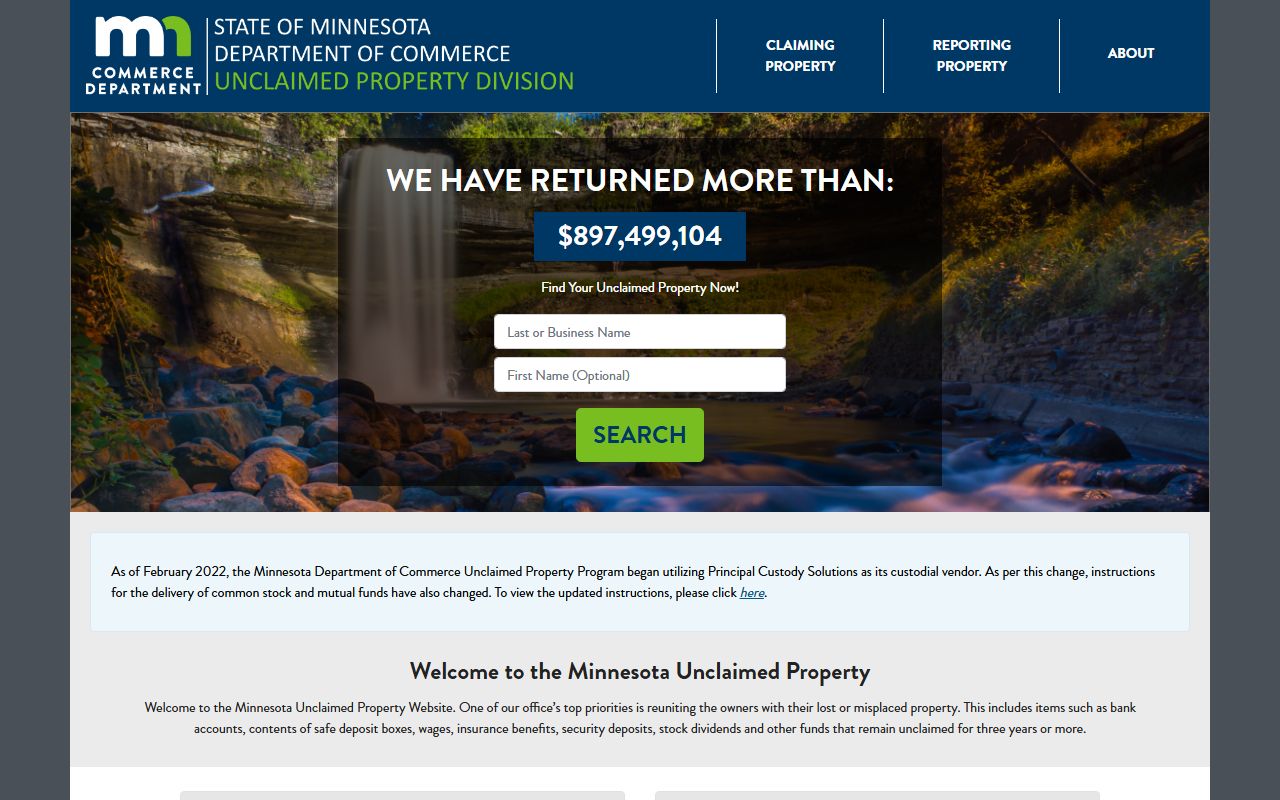
The state portal at minnesota.findyourunclaimedproperty.com holds all unclaimed property reported by Cook County holders. The search is free and available at any time.
How Cook County Residents Search
Type your full legal name into the state portal. Scan the results for anything familiar. The original holder's name appears in the listing, which can help you connect the property to a specific account or service you once had. If you recognize the business, that is a strong sign the property may be yours.
Cook County has a sizable seasonal population. Cabin owners and part-time residents may have had utility accounts, contractor deposits, or local business accounts in the county that never got fully resolved when they were away for a season. These can end up as unclaimed property if the business lost contact with the owner. If you have owned property in Cook County, even briefly, it is worth checking under your name and any business names associated with that property.
Try variant spellings and former names too. A maiden name, a nickname, or an old business name can pull up results that would not appear under your current name. Heirs of deceased residents should also search. If someone who lived in Cook County passed away with property in the state system, a qualifying heir can file a claim with proper documentation.
For a broader check, use MissingMoney.com. This national tool searches across multiple state databases at once, which is helpful if you or your family have also lived in Wisconsin, Michigan, or other states bordering the Great Lakes region.
Note: The state portal is the only official source for Cook County unclaimed property and all searches and claims there are completely free.
Types of Unclaimed Property in Cook County
Unclaimed property from Cook County covers a range of asset types. Dormant bank accounts are the most common. Uncashed checks from utility companies, healthcare providers, and government agencies follow. Life insurance proceeds that beneficiaries never claimed are another significant category. For a county with seasonal businesses, end-of-season deposits, vendor balances, and payroll checks that were never cashed can also appear in the database.
Under Minnesota Statutes Chapter 345, the dormancy period for most financial assets is three years. A bank account with no activity and no owner contact for three consecutive years becomes reportable to the state. Safe deposit box contents have a longer dormancy window of five years. There is no minimum dollar threshold. Any abandoned balance, large or small, must be reported once the applicable dormancy period ends. All Cook County holders file their annual unclaimed property reports by November 1.
A 2019 amendment to Chapter 345 added a requirement that interest on interest-bearing property be preserved. When a savings account or certificate of deposit goes unclaimed and that account was earning interest, the accumulated earnings stay with the property. Claimants receive both the principal and the interest that built up while the state held it.
Claiming Cook County Unclaimed Money
The claim process uses four steps: search, submit, complete, and track. Go to the state portal, find the property, click to start a claim, fill in the required information, and submit. The portal assigns a Claim ID when the submission is complete. Use that ID to check the status of your claim online at any point during the 90-day processing window.
For most personal claims, a government-issued photo ID is the main document required. If you are claiming for a deceased person as an heir, bring a death certificate and documentation proving your legal authority over the estate. This might be a probate court order, letters testamentary, or another legal instrument depending on the situation. Business claims require proof you are authorized to receive funds on behalf of the entity. You can upload documents through the portal or mail them to 85 7th Place East, Suite 280, St. Paul, MN 55101.
Give the Department of Commerce up to 90 days to review and pay the claim. If you have not received an update by then, call 651-539-1545 or use the toll-free number 1-800-925-5668. You can also email unclaimed.property@state.mn.us. There are no fees at any stage of the process.
Minnesota Unclaimed Property Law
Unclaimed property in Cook County is governed by Minnesota Statutes Chapter 345. This law, the Uniform Disposition of Unclaimed Property Act, covers all aspects of how abandoned property is identified, reported to the state, held, and returned to owners. It applies to all 87 counties equally, and Cook County is no exception.
Under Minnesota Statute 345.41, holders of unclaimed property must file a verified annual report with the Commerce Commissioner by November 1. Life insurance companies have an October 1 filing deadline. For property worth $100 or more, the holder must first send the owner a written notice at least 120 days before the filing deadline. That notice gives the owner a chance to respond and avoid the transfer. Holders with nothing to report must still file a negative report each year to confirm compliance.
Penalties for non-compliance are specified at Minnesota Statute 345.55. Willfully failing to file a required report is a misdemeanor. Refusing to pay or deliver property to the Commissioner after a written demand is a gross misdemeanor. In addition, interest accrues at 12 percent per year on property not delivered after a demand is made. These penalties target businesses, not property owners.
Additional Resources for Cook County Residents
The NAUPA Minnesota profile lists the Department of Commerce contact details and a direct link to the state portal. NAUPA is the national authority on unclaimed property programs and provides a reliable way to verify you are using official sources.
If you believe you are owed money from a federal bankruptcy case, check the U.S. Bankruptcy Court for the District of Minnesota. The court holds unclaimed dividends from bankruptcy distributions that went uncollected. Claiming from the bankruptcy court is a separate process from the state program.
The Minnesota State Auditor publishes guidance on unclaimed property compliance for public bodies. The resource explains how local governments and public entities are expected to identify and report property they hold, which helps provide broader context for how the overall system works across the state.
Nearby Counties
Cook County borders these Minnesota counties to the west and south. All use the same state unclaimed property system.