
Duluth Unclaimed Money Lookup
Duluth sits on the western tip of Lake Superior and serves as one of the busiest freshwater ports in North America. The city's long history in shipping, iron ore, and Great Lakes commerce has left a trail of financial accounts, vendor payments, and insurance policies that over time can go dormant and end up in the state's unclaimed property database. Duluth residents who want to search for unclaimed money can do so for free through the Minnesota Department of Commerce's online portal. It takes a few minutes, requires no account, and covers all funds held on behalf of Duluth and St. Louis County residents.
Duluth Overview
Searching Duluth Unclaimed Money
The official search portal for Duluth unclaimed money is at minnesota.findyourunclaimedproperty.com. The Minnesota Department of Commerce holds all unclaimed property in a single statewide database. Duluth is in St. Louis County, and all property reported with a Duluth address is in that database. There is no separate Duluth or St. Louis County search. One free portal covers all of it.
Searching is simple. Enter your last name and first name. The portal returns any matching results, along with the type of property and the name of the holder who reported it. That holder name is often a bank, an insurance company, a utility, or a former employer. Seeing a familiar name in the results is usually a strong signal that the record belongs to you.
Try every name you have used over the years. Maiden names, former married names, and name variations all return separate results. If you lived at multiple Duluth addresses, try searching by those too. Business owners should search company names in addition to their personal names. Partial name searches work when you are unsure of spelling. The portal is built for flexible searches, so broader terms often turn up more results than narrow ones.
Duluth has a mix of long-time residents and a rotating population of students at the University of Minnesota Duluth and other institutions. That mobility means accounts and deposits tied to Duluth addresses often go dormant when people move on. Searching periodically is worth doing, especially if you have not checked in several years.
The City of Duluth's Finance Department handles city financial matters including budgeting, accounting, grants, and treasury functions.
The Duluth Finance Department manages city financial operations, including budget oversight and treasury management for the port city.
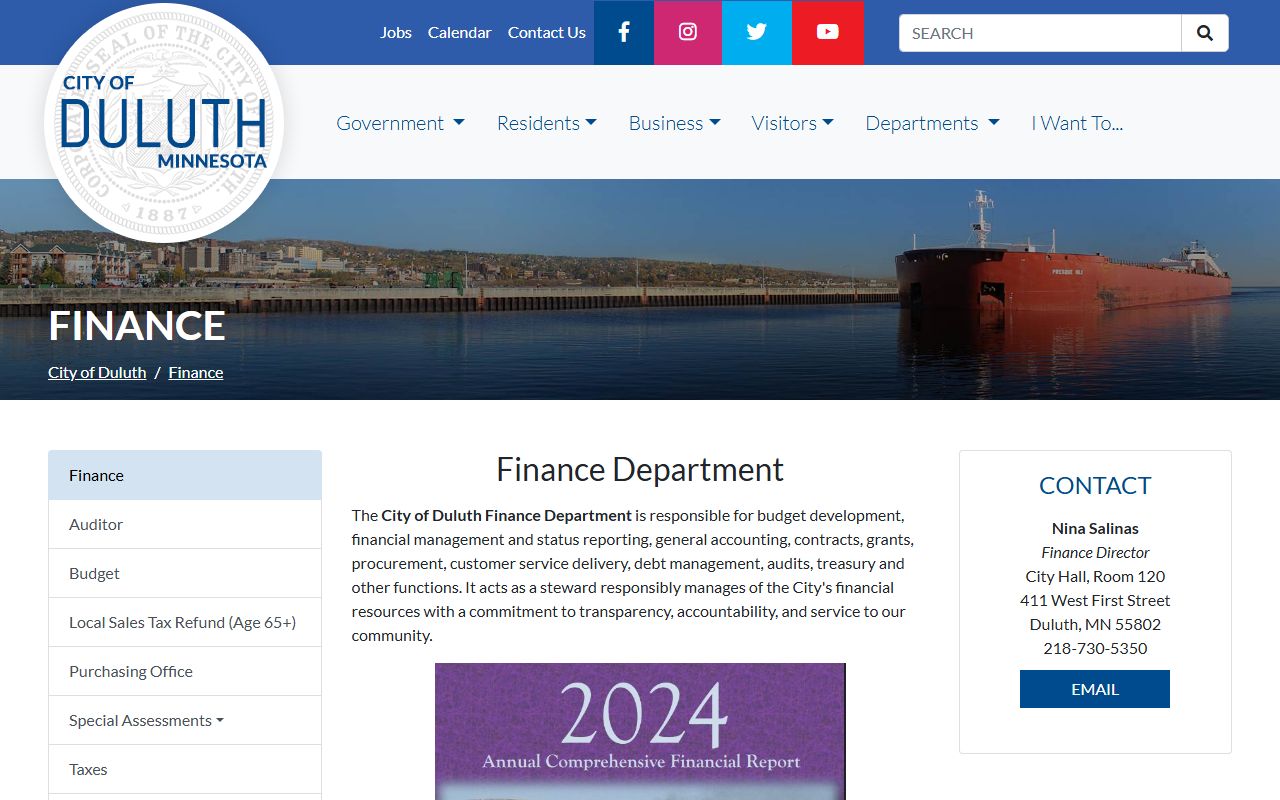
The Finance Department is a city government office. All unclaimed property searches and claims use the state portal, not city offices.
Duluth Unclaimed Property Sources
Duluth's identity as a major port city shapes the types of unclaimed property that appear in the state database. The Port of Duluth-Superior is one of the largest freshwater ports in the world, and the shipping industry generates a lot of financial activity. Contracts, vendor payments, shipping company checks, and cargo business transactions all create potential for unclaimed funds when businesses change, merge, or close and final payments never get collected.
Bank accounts are the most common type of unclaimed property statewide, and Duluth is no different. Savings accounts, checking accounts, and CDs all become unclaimed after three years with no activity or contact. Duluth has a number of local and regional bank branches, and dormant accounts from people who moved away, passed on, or simply lost track of old accounts end up in the state database each year. If you had a bank account in Duluth at any point, it is worth checking.
Insurance is another major source. Life insurance policies, annuity contracts, and health savings accounts all get reported when the holder cannot locate the beneficiary or account owner. Duluth's industrial and port workforce has historically included union workers with pension and insurance benefits, and older policies from that era sometimes go unclaimed for years before a family member eventually searches the state database. The amounts can be significant.
Other types include utility deposits from former residences or businesses, dividend payments from mining and shipping companies tied to the region, uncashed vendor payments, court-ordered settlements, and safe deposit box contents. St. Louis County is the largest county in Minnesota by area, and it has a long industrial history that generates its own layer of unclaimed property tied to mining, forestry, and port commerce.
How to Claim Duluth Unclaimed Money
The claim process follows four steps. Search the state portal and find a result that looks like it belongs to you. Submit a claim online through the same portal. The system assigns a claim ID immediately so you can track your claim. Gather and submit whatever documentation the state requests. Then wait for processing, which takes up to 90 days from the time your complete documentation is received.
The documents you need depend on the property type and the amount. Most straightforward claims need only a government-issued photo ID. Larger or more complex claims may also require a document connecting you to the address listed on the property record. A utility bill, bank statement, or lease tied to your Duluth address at the time of the account works well. If you are claiming on behalf of a deceased family member's estate, you will need a death certificate and letters of administration or other legal authorization from a probate court.
You can file your claim online through the portal or by mail. Mail submissions go to: Minnesota Commerce Department, 85 7th Place East, Suite 280, St. Paul, MN 55101. You can call the unclaimed property office at 651-539-1545 or 1-800-925-5668 with questions, or email unclaimed.property@state.mn.us. Everything is free. No fees at any point in the process, from search to payout.
Minnesota holds unclaimed property indefinitely. There is no deadline to file a claim. Funds that were reported a decade ago are still available and can be claimed today. Do not assume old funds are gone.
Minnesota Unclaimed Property Law
The law governing Duluth unclaimed money is Minnesota Statutes Chapter 345. This chapter covers how businesses and other holders must report dormant property, how the state manages those funds, and how owners can reclaim them. The law applies to all property held on behalf of Duluth and St. Louis County residents, regardless of where the reporting company is based.
Most property types have a three-year dormancy period under Minnesota Statute 345.41. After three years of no contact between the holder and the owner, the holder must report the property to the state. Safe deposit boxes follow a five-year rule. Life insurance companies face a different timeline based on the insured's death or would-be age, and they must file by October 1 each year. All other holders file by November 1.
Before reporting, holders must notify property owners when the value is $100 or more. That notice must go out at least 120 days before the filing deadline. The owner can contact the holder during that window and reclaim the funds without the state ever getting involved. Many people reclaim property this way, through a notice letter from an old bank or insurance company, before the funds are even reported.
Minnesota updated its law in 2019 to require the state to pay interest on interest-bearing property. If your claim covers a savings account or other interest-generating asset, you may receive more than the base amount reported. Rules for distribution are at Minnesota Statute 345.55.
Other Resources for Duluth Residents
The state portal covers all property reported to Minnesota, but some funds end up at the federal level. If you or a family member had a case in federal bankruptcy court, unclaimed distributions from that case are held by the U.S. Bankruptcy Court for the District of Minnesota. That list is maintained separately from the state database and needs to be searched independently.
For a search covering multiple states at once, MissingMoney.com is a free tool run by NAUPA, the National Association of Unclaimed Property Administrators. It queries most U.S. states simultaneously. This is especially useful if you or a family member ever lived outside Minnesota, since funds get reported in the state where the account or property was held. The NAUPA Minnesota profile provides additional background on how the state program works and what categories of property are most commonly reported each year.
Duluth is the county seat of St. Louis County. For questions about county-issued payments or county government financial matters, contact St. Louis County directly. For all unclaimed property claims tied to Duluth addresses, the state portal remains the right starting point.
St. Louis County
Duluth is located in St. Louis County. All unclaimed money searches for the area go through the state portal.